Food Insecurity and Violent Extremism: UNICRI's Strategic Response
Food Insecurity and Violent Extremism: UNICRI's Strategic Response
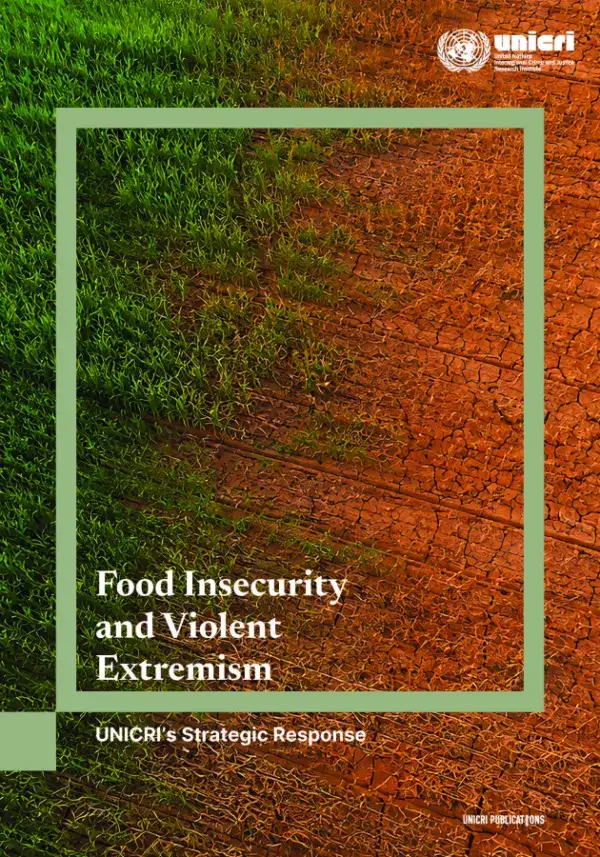
Food insecurity and violent extremism are among the defining challenges affecting peace, security and sustainable development in many regions of the world. While there is no direct causal relationship between the two, food insecurity can, in certain contexts, exacerbate grievances and vulnerabilities that violent extremist groups exploit for recruitment, influence and territorial control.
This publication examines the complex and context-dependent relationship between food insecurity and violent extremism, drawing on recent international research and UNICRI's work on preventing and countering violent extremism. It explores how conflict, climate change, weak governance, economic shocks and social marginalization interact to create environments where extremist actors can exploit disrupted food systems, while emphasizing that food insecurity alone does not inevitably lead to violent extremism.
Moving beyond analysis, the report presents UNICRI's Strategic Response Framework, a practical six-pillar approach designed to support national and regional stakeholders in integrating food security considerations into prevention strategies. The framework promotes evidence-based research, risk analysis, protection of food systems, locally-led resilience, early warning mechanisms, and policy coordination, while upholding humanitarian principles and avoiding the securitization of aid.
UNICRI's strategic response framework pillars
Action-oriented research
Evidence and risk analytics
Protecting food systems in conflict
Locally led resilience and livelihoods
Early warning for prevention
Policy alignment, law and finance
Importantly, the framework emphasizes that integrating food security into prevention strategies must never compromise humanitarian principles or result in the securitization of aid.